

How I Expect Enterprise Applications to Change in 2025

The enterprise application sector is poised for a dramatic change in 2025. Requirements for modernization, innovation, and adaptability will drive this transformation. So much so, that the modernization services space, appraised at $17.19 billion in 2023, is forecasted to swell to $60.87 billion by 2032, expanding at a CAGR of 15.48% throughout the projected period (2024–2032).
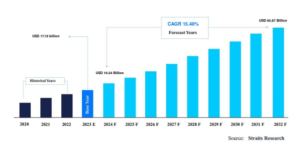
Credit: Straits Research
This explosive growth also reinforces the desire among organizations to upgrade, refresh, or replace their current software applications. The sense will grow that they need to do so to stay current in a continually changing tech environment. Application modernization – upgrading the legacy systems to meet current business needs, technology fluctuations, and user demands, therefore has emerged as an important approach for enterprises to develop and increase functionality, performance, and competitiveness.
As we enter another year, it’s good to explore upcoming trends, tech advancements, and strategic approaches that will shape enterprise application modernization in 2025. This piece will consider the pivotal developments influencing this transformation, focusing on emerging trends, recent tech updates, and forward-thinking strategies that will propel businesses forward amidst the curve.
Trends Likely to Shape Enterprise Application Modernization in 2025
Cloud-Native Development
In 2025, cloud-native development will matter greatly, with Gartner expecting more than 85% of firms to adopt a cloud-first approach. By then, over 95% of new digital workloads will depend on cloud-native platforms, a substantial increase from the 30% seen in 2021. This transition is fueled by cloud-native architectures offering scalability, flexibility, and resilience, achieved through microservices, containerization, and the use of Kubernetes, thus speeding innovation and simplifying operations.
Low-Code and No-Code Development
Low-code and no-code platforms are transforming enterprise app development, allowing swift creation and empowering non-tech employees. Gartner expects around 70% of new apps by 2025 to use these tools, a stark contrast to the less than 25% in 2020. Low-code application platforms (LCAPs) let non-IT staff craft tailored solutions, acting as “business technologists.” This shift boosts agility, speeds time-to-market, and enhances collaboration among IT and business sectors.
Rising Expectations for User Experience (UX)
Design’s pivotal role in shaping user experience underpins 94% of first impressions. Investing $1 in UX yields $100 in return (ROI = 9,900%), indicating its remarkable profitability. Businesses that adopt top-notch design methodologies exhibit growth 2X as swiftly as industry benchmarks. With customers seeking seamless and captivating app experiences, enterprises need to emphasize UX to foster adoption, loyalty, and distinctive marketplace positioning.
Personalization and Data Tracking
Personalization’s impact on user engagement remains significant, evidenced by 76% of consumers valuing customized messages and 78% being more likely to repeat business with personalized experience providers. Yet, user trust mandates that 69% expect personalization to stem from data they willingly submit; thus, businesses harnessing data & analytics to facilitate thoughtful, transparent personalization can foster greater trust and loyalty.
Demand for Resilient and Flexible Architectures
Resilient architectures are vital for modern businesses to keep functioning through disruptions. Key traits include fault tolerance, redundancy, and quick bounce-back, which ensure consistent service provision. Scalability and elasticity boost adaptability to varying workloads. Focusing on resilience helps firms offer dependable user experiences and sustain operations during tough times.
Hardware Infrastructure Modernization
Enhancing hardware infrastructure is crucial for supporting modern applications. Obsolete systems often fail to accommodate AI, advanced analytics, and edge computing capabilities. New solutions, like GPUs and edge servers, improve performance and efficiency, facilitating real-time processing. Investing in refreshed hardware enables enterprises to effectively harness potential emerging technologies.
Technology Updates Likely to Influence Enterprise Applications in 2025
Gen AI and ML
Enterprise applications stand to be profoundly shaped by Gen AI in 2025, with advancements such as Google’s Bard and Open AI’s ChatGPT propelling progress. Bloomberg projects the Gen AI market to explode to $1.3 trillion over the next decade, escalating from just $40 billion in 2022. Beyond Gen AI, ML will augment predictive analytics, streamline procedures, and elevate decision-making across industries, catalyzing innovation.
Edge Computing and IoT Integration
Edge computing and IoT significantly contribute to enterprise modernization. Acknowledged by 83% for future competitiveness, its use currently stands at 65%. Alongside, IoT adoption escalates, with an estimated 16.6 billion connected devices forecasted for 2023, to reach 18.8 billion by 2024, as per IoT Analytics. Jointly, edge computing and IoT facilitate real-time data processing and localized decision-making essential for sectors such as manufacturing, healthcare, and logistics.
DevOps and CI/CD Integration
DevOps and CI/CD are transforming application development paradigms. A Harvard Business Review finding indicates that 86% of entities now see DevOps as “important to have.” These techniques foster expedited development routines, enhanced teamwork, and heightened flexibility. Incorporating CI/CD workflows enables businesses to boost software release velocity without compromising on quality.
Zero-Trust Architectures
As digital threats advance, cybersecurity importance grows, driving enterprises to prioritize zero-trust architectures. Survey data by Gartner suggests that about 63% of global organizations have implemented these strategies fully or partly. This system negates implicit trust, instituting stringent access regulations and constant authentication. This allows businesses to more effectively safeguard software from intrusions and unpermitted use.
Containerization and Kubernetes
Containerization, backed by orchestration platforms such as Kubernetes, is changing the landscape of application deployment and administration. These solutions empower corporations to attain enhanced adaptability, scalability, and portability across varying systems. Ensuring uniform performance, containerization, when coupled with Kubernetes, automates the process of scaling and resource management, thereby boosting operational effectiveness.
Composable and Serverless Architectures
Composable and serverless architectures are rising in popularity thanks to their efficiency and flexibility. Datadog’s findings show a notable surge in serverless adoption, with Azure and Google Cloud up 6% and 7% respectively, and AWS growing by 3% over the past year. Composable architecture boosts modularity, allowing enterprises to construct applications from interchangeable parts. This approach aids in adapting to changing needs, cutting down costs, and enhancing scalability.
Strategies for Enterprises to Stay Ahead in 2025
- Modernize IT Infrastructure: Replace legacy systems with modern hardware, cloud platforms, and the latest technologies for better efficiency and adaptability.
- Opt for Flexible and Scalable Solutions: Modular, cloud-native architectures will support growth, enhance agility, and optimize resources.
- Deliver Customer-Centric Experiences: Invest in UX/UI for driving frictionless experiences, personalized to assure loyalty and engagement.
- Improve Data Management Practices: Centralize data, ensure quality, and maintain compliance for unlocking insights that support decision-making.
- Ensure Security and Compliance: Apply zero-trust models, perform risk assessments, and adapt to changing regulations to protect assets.
- Engage with Strategic Technology Partners: Accelerate innovation and growth by leveraging the expertise and advanced solutions provided by technology partners.
Conclusion
The enterprise application landscape is in a state of flux due to the rise of emerging technologies, changing user expectations, and increasing demand for agility and resilience. Businesses can unleash new capabilities, improved user experiences, and long-term competitiveness by embracing modernization strategies. As 2025 approaches, staying informed and proactive in adopting these transformative trends will be key to thriving in an evolving digital environment.
Recode Solutions enables digital transformation for enterprises at unprecedented speed with high-end Industry 4.0 technology services. Equipped with Gen AI, automation, data analytics, DevOps, and integration experience, we modernize enterprise applications and pave the way for businesses. Power your growth and efficiency with the help of our robust automation and data engineering frameworks to cater to custom solutions. Ready to future-proof your enterprise applications? Let’s get started today.